Showing posts with label NHS. Show all posts

Thursday, 29 October 2015

Is it time the food industry was brought into line?

No, I'm not talking about the sugar tax that has had a significant amount of news and hype around it recently. Nor am I talking about salt content, or any of the other myriad of conversations around nutritional levels in food.

I'm talking about the industries use of the word "diabetic" and phrase "suitable for diabetics" to promote their products. The industry is essentially exploiting the health of those with diabetes and their friends and family who think they are helping when they buy these products at extortionate prices.

Back in 2002 Diabetes UK teamed up with the Food Standards Agency to issue a joint statement on "diabetic" food, this was reinforced in 2007 with a further statement.

With it came some initial success. Boots UK who had been selling a "diabetic" food range changed the labelling removing the word diabetic. Unfortunately it wasn't long before Boots decided it preferred profits over the health education of our country.

In March 2010 a Boots UK spokesperson commented:
"Boots UK takes the opinion of customers very seriously. In 2002, on the advice of Diabetes UK we removed our Diabetic Food Range. However, we received significant, sustained customer complaints about the lack of a specifically labelled Diabetic Food range at Boots UK and we always listen to their feedback carefully."
"Our customers told us that they liked the peace of mind of being able to buy 'treat' foods clearly labelled as suitable for those living with diabetes. In light of this customer reaction, we took the decision to reinstate the Diabetic Food Range in 2005. The range is designed to offer occasional 'treat' food that those with diabetes often miss, such as no added sugar chocolate. These occasional foods are not designed to be a main part of a balanced diet. Boots UK recommends that people with diabetes follow a healthy, balanced diet with a wide variety of foods, and we offer advice and information in store and online and our pharmacists are available to help and offer lifestyle advice. We listen to our customers and care about their opinion – we are aware of the issues surrounding this type of range and carry out regular reviews."

How far does it go?


But it's not just Boots UK that are cashing in on what I'm crudely going to call the "diabetic pound".

Thorntons Chocolate have what they are now calling the No Added Sugar Chocolate range, but look at the packaging and it is clearly labelled as diabetic.

One example of Thorntons Diabetic chocolate range

Debenhams Flowers sell a Thorntons Diabetic Selection Pack which turns out to be 596 grams of chocolate for the bargain price of £28.99 and given the laxative effect of polyols, a day on the loo is most probably included for free too!

Even Hotel Chocolat, who when challenged claim to agree with and support the Diabetes UK positional statement on diabetic food, blatantly ignore the fact they are marketing food "suitable for diabetics". In this instance they aren't using polyols but instead a high cocoa content as their reasoning. At least that means you don't have the joys of the polyol laxative effect, but never-the-less they are very much joining in with the rest of the industry in cashing in on the "diabetic pound".

There are many more examples of "diabetic" food products from jam to cookies to fruit sweets to cakes and even ice cream! Yes diabetic ice cream! Franks Ice Cream has a range of "diabetic" ice cream which I'll come back to shortly.

Diabetic Food and the NHS


When I was initially diagnosed with diabetes one of the first things I was told by my practice nurse was:

"Don't buy diabetic food, it's expensive, will put you on the toilet and has no advantage over the products they aim to replace".

Excellent advice and it's something that I hear is shared by most HCPs around the country. It didn't stop my friends and family trying to be helpful and buy me diabetic chocolate - regularly! - but at least patients are getting good advice and they can hopefully educate those around them against the huge marketing machine of the food industry.

So imagine my shock and horror when I find out the NHS isn't following it's own advice! Pretty much every hospital website has a document discussing food and diabetes which has a statement along the lines of:

"Don’t be tempted to buy diabetic foods. They are expensive, can still affect your blood sugar levels and often have a laxative effect. They also contain just as much fat and as many calories as non diabetic foods. Occasional small portions of the ordinary product would be a better choice."

Some examples of this can be found at University Hospitals Coventry & Warwickshire (bottom of page 2), Tameside, Glossop and Stockport (top of page 5) and Derby Hospitals (page 6).

Yet, if you are an inpatient at hospital then potentially, if you select ice cream from the menu, you might be eating Franks Diabetic Ice Cream! In fact when you go on to Franks Ice Cream website they are almost using the NHS as an endorsement for their product!

Franks Ice Cream showing off they are an NHS contracted supplier
This shouldn't be allowed. I suspect (and this is a complete guess!) the reason might be that many inpatient catering contracts are actually run by companies on behalf of the NHS and those contracts only specify certain nutritional requirements but, whatever the reason, patients in NHS hospitals should not be given "diabetic" foods.

Drilldown on a couple of products


Let's compare Franks "diabetic" ice cream to a really indulgent vanilla ice cream. Let's see just how much of a difference the diabetic version has on the amount of carbohydrates consumed.

Franks Diabetic
Vanilla Ice cream
Haagen-Dazs
Dairy Vanilla Ice Cream
Carbohydates (per 100g)19.7g20.2g
Of which sugars (per 100g)13.8g14.3g

A whopping 0.5g of extra carbohydrates per 100g of ice cream (100g is approximately 2.5 scoops of ice cream) if you go for one of the most indulgent vanilla ice creams available over Franks diabetic version. In real terms, the amount of insulin required to deal with both of these products is exactly the same.

What about those Thornton chocolates?

Well, if you buy them, don't eat more than two chocolate pieces a day because Thorntons themselves point out that three pieces is deemed an excessive amount of polyol consumption and will cause you problems!

WARNING: Excessive consumption may cause laxative effects. We recommend eating no more than 20g of polyols per day, though children or particularly sensitive people may react to levels lower than this.

...but let's take a look at the carbohydrates. This time against one of my favourites, Diary Milk chocolate...

Thorntons No Added Sugar
Caramel and Fudge
Cadburys
Diary Milk Chocolate
Carbohydates (per 100g)61.3g56.5g
Of which sugars (per 100g)3.2g56g
Polyols57.1g0g

So, Cadburys Diary Milk has slightly less carbohydrates than the Thorntons diabetic chocolate. The profile of the blood sugar spike will be different but here is the rub... if you eat those Thorntons chocolates and need to take insulin you don't really know how much of that 61.3g you need to inject for. Why? Because, to not put to finer point on it, you don't know how much of those polyols will just "go through" you.

Where do the supermarkets stand?


Given Diabetes UK works closely with Tesco I had imagined Tesco might be leading the pack when it comes to policy around diabetic ranges, especially since the Diabetes UK positional statement clearly states as one of its calls to action:

"Retailers are recommended to stop selling ‘diabetic’ foods."

Unfortunately a quick look on their website shows this not to be the case. I could find no policy statement about diabetic foods and they sell a range of diabetic ice cream and jam products.

Morrisons have double standards. On the one hand, they have a policy around diabetic food in line with the Diabetes UK positional statement


...but happily sell a range of products labelled diabetic from icecream to jam!


Back in April 2010, Asda specifically asked people what diabetic food they wanted
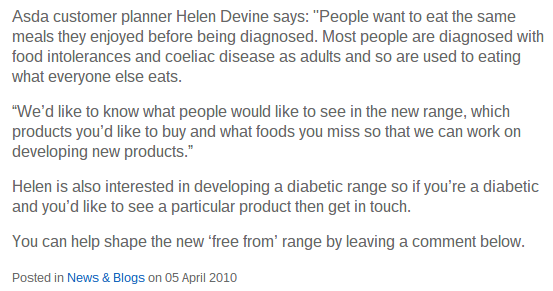

Not only did they want to create a diabetic range they were calling customers who had diabetes diabetics. A big no-no in my book. It looks like they didn't take that idea forward, but they do sell diabetic ice cream.

Waitrose has a page dedicated to diabetes, once again we see a supermarket calling its customers who have diabetes diabetics (and they also use the phrase diabetic control - another no-no!) and they clearly point out there is no need to buy diabetic products.


.
..but following the double standards of Morrisons you can happily buy diabetic jam and ice cream.

Marks and Spencer also have a whole page on how to be healthy with diabetes, referring people to the Diabetes UK website and making it clear "suitable for diabetics" products should be avoided.


It's difficult to be sure but I'm not aware of any products specifically labelled as diabetic in M&S - more research is needed!

And finally, Sainsburys. Sainsburys has a policy referring people to the Diabetes UK positional statement but like many of the other supermarkets they are calling their customers with diabetes diabetics.


Unlike Morrisons and Waitrose however they seem true to their word and I can find no products labelled diabetic. Please let me know if you know of any products that they sell that doesn't align with their policy statement above.

But even Sainsburys isn't impervious to the food industries marketing machine, with many products now having the claim "suitable for diabetics" somewhere on the product labelling. The most common place to find them is on chocolate and sugar products. One example is Choc Shots, which like all the food in the store is suitable for people with diabetes as part of a healthy diet.

"suitable for diabetics (as part of a healthy diet)"

Asda even manages to sell soup that is apparently "suitable for diabetics" - who would have thought someone with diabetes could eat soup! *sigh*

Sarcasm on full: Soup I can eat - it must be a first! 

I'd certainly like to see the supermarkets take more of a stand on this issue and put some pressure on the food manufactures to change their labelling and remove references to diabetics. Supermarkets definitely need to be part of the solution and not part of the problem. I have no problem with products being labelled as low in sugar or low GI, but that does not make them diabetic or suitable for diabetics!

Regulation, laws, directives...


Surely the law regulates this kind of thing? Isn't the food industry one of the most highly regulated industries? How do they get away with it? Well I'm no lawyer and looking at all the regulations and directives all that is clear to me is that these documents are impenetrable and instantly cause my brain to switch off given the language used.

What I do know is the European Food Safety Authority states:

Health claims made in relation to food products require authorisation under Regulation EC 1924/2006 before they can be used in the labelling and marketing of these products in the EU

Within that regulation point 22 says:

(22) Conditions for claims such as ‘lactose-free’ or ‘gluten-free’, addressed to a group of consumers with specific disorders, should be dealt with in Council Directive 89/398/EEC of 3 May 1989 on the approximation of the laws of the Member States relating to foodstuffs intended for particular nutritional uses ( 9 ). In addition, that Directive provides the possibility that foodstuffs for normal consumption can indicate their suitability for use by these groups of consumers if they fulfil the conditions for such statement. Until the conditions for such statements are set at Community level, Member States may maintain or adopt relevant national measures.

I have no idea what the directive means in real terms. I also found this document Proposal for a Regulation of the European Parliament and of the Council on foodintended for infants and young children and on food for special medicalpurposes (First reading) (Legislative deliberation) with lots to say on the subject such as:

(7) Directive 2009/39/EC foresees that specific provisions could be adopted regarding the two following specific categories of food falling within the definition of foodstuffs for particular nutritional uses: 'food intended to meet the expenditure of intense muscular effort, especially for sportsmen' and 'food for persons suffering from carbohydrate metabolism disorders (diabetes)'. As regards special provisions for food for persons suffering from carbohydrate metabolism disorders (diabetes), a Commission report to the European Parliament and to the Council concludes that the scientific basis for setting specific compositional requirements is lacking

I'm totally baffled. Hopefully someone with a better understanding of the law can explain the rules in terms that mere mortals can understand but, the long and the short of it is, "diabetic products" are out there; products claiming to be "suitable for diabetics" are out there and; this marketing approach is increasing. In my eyes this is wrong but what can be done?

Should we be lobbying the food industry? Challenging the NHS on the food they provide to inpatients? Lobbying the supermarkets to apply pressure for change? Lobbying our MPs to tackle this issue? Or as Diabetes UK positional statement says "Members of the public can make complaints about food labelling that they consider to be misleading to their local Trading Standards team"? Well, maybe we should be doing all of these things.

What do you think?

Tuesday, 5 August 2014

Why measure? Is it waste or non-compliance?

Two topics in one blog post? Well, they are kind of related and I'm in a cost and time saving mood...

Why measure?

Recently I've (unfortunately) been going to the hospital and my new GP practice a lot more than normal. Sometimes I've had hospital visits twice in one week and although the observation I'm about to make has struck me as odd before, these regular visits have made me question what is going on even more.

Every time I've had an out-patient visit something happens and yet, nothing happens.

What happens? I get weighed and my height is measured.

Now I'm being a bit harsh when I say nothing happens because in reality the results get recorded on the system but, after that, nothing happens.

If I were to visit the hospital today, my weight and height would be recorded. If I visited tomorrow, I would (once again) be weighed and my height measured.
No one stops and thinks "Oh, this was recorded yesterday, no need to do it today". It seems to "just be the procedure". It seems a waste of time and effort.

What's worse is that no one seems to look at these measurements or, if they do, they see no reason to discuss them with me - yet they should. My weight has increased by over 50% in the last year and my BMI wasn't in the green zone to start with!

So why is this procedure blindly followed every time I visit hospital or visit my GP practice?
If the data isn't used, why collect it in the first place?
If I refuse to be weighed or have my height measured I suspect I'd be deemed a non-compliant patient, which nicely leads on to part two of this blog post...

Is it waste or non-compliance?

I have a new GP!

I have no idea who they are. I don't know their name as it could be any one of the GPs at the practice I've registered at, but I'm sure the system knows who I've been nominally assigned to.
If it's anything like the last two practices I've been registered with, I suspect I will never see them. Instead I'm always seen by the practice nurse, because I'm "special"... I have type one diabetes... which is fine my me - being seen by the practice nurse, not so much the diabetes bit!

When I initially registered I was told that they no longer do "new patient assessments" - fantastic. I always found them to be annoying time wasting activities imposed on me so I'd be allowed to order a repeat prescription. I asked how my repeats would be setup and (unfortunately), whilst casting their eye over my last repeat prescription, they back tracked a bit and said "well the GP might want to see you before setting all this up".

I realised, the following week, that I hadn't asked about sharps bins. Unlike my previous two addresses, were the council both took away and replaced sharps bins, my current council only takes sharps bins away.
I went back to ask how I could get a replacement sharps bin. Apparently I need a sharps bin to be added to my prescription (which to this day still hasn't been done). The council will come and collect my bins on the 8th so it might be an interesting challenge to store my medical waste soon!
Anyway, whilst this was being discussed I was told that I needed to be booked in to see the practice nurse to discuss my diabetes and get my repeats setup etc... sounds like a new patient assessment to me! As a "compliant" patient I set up the appointment, after all, if I didn't get my repeat of insulin I'd be putting myself at risk of dying - no small incentive.

Unfortunately the practice nurse was ill on the day I was meant to see her and the GP practice rang to rearrange for the following week.

The day arrived. I go with my urine sample, all of my notes and a list of issues and questions I'd like to discuss - I always go prepared.

Some of the numerous forms I filled in to register at my current GP practice.
Including key questions: Do I smoke? Do I drink? Do I exercise?
I get weighed; they measure my height; they do my blood pressure; ask if I drink?; do I smoke?
...and a couple of surprise statements/questions: You have type two diabetes. What other conditions do you have?

At registration I'd provided a printout from my previous GP listing everything about me. I'd also filled in numerous forms to register with practice too (one of which asked if I smoked, how much I drank and the amount of exercise I do). I also knew that (because they'd taken so long registering me) my previous GP had managed to send through everything they had about me. Heck I even knew (via the EMIS patient portal) that my repeats had been setup and so this meeting was a complete waste of my time - I didn't need to be here to get my repeats setup as I'd previously been told! So why was I being asked all this stuff - again?

The NHS love to record when and how much I drink & smoke.
Just like weight and height - it's an obsession.

Even when I was admitted to hospital on the verge of coma I was asked! Yes, I know, there is good reason for this... but I must always disappoint them when they get the same response:

"only for celebrations and no, never"

How boring! ...but every time it's as though they're asking these questions for the first time. No one has ever said "We've recorded on the system that you don't smoke, is that still the case?". Why bother recording the information if it's never going to be looked at again?

Then the question (spoken as a fact), that always annoys me, was made:

"You have type two diabetes."

I interject, "No I don't. I was mis-diagnosed with type two diabetes. I actually have type one."

"Oh. What other conditions do you have?"

I mention Raynauds.

"How do you spell that?"

The system shows three different options for Raynauds and I point out they all describe the same condition. She selects one and then asks me a question about it that makes no sense what-so-ever. She decides not to explain, presumably because she doesn't know what the question means either.

I sit there wondering why I'm being asked all this when they have all of my medical notes already. Maybe they're doing this to check the information is right? Well if I didn't have type one diabetes I wouldn't be here, so it can't be that... besides, she's typing this stuff into the system whilst I'm here. Why hasn't it all been imported electronically already?

...and then it is back to discussing my diabetes...

"Have you had a retinal screening this year?"
"Yes, 8th of May" (I know this because I blogged about it: Eyes Wide Open)
"Was it ok?"
"Yup, no problems."
"Ok, we'll get you added to the system to have one later then."

Then came the shocker.

"We need to set you up with a couple more appointments. One to have a fasting blood test and the other to see the diabetes nurse at the practice."

What started as not requiring any appointments has turned into three!

So I'm booked in next week for blood tests (let's hope I don't go hypo before that one!) and the following month to see the diabetes nurse to discuss whatever it is she wants to discuss - assuming I go. At some point someone needs to re-test my potassium levels... I seem to be the only one concerned about this, hopefully I can convince them to do that next week otherwise I'll cancel the appointment with the nurse because I don't see any value to it.

As the practice nurse starts to send me on my way I say I have a few concerns and questions I'd like to ask. It turns out she can't help with any of them, only the diabetes nurse can deal with these when I see her next month. I guess I'll just plod on by myself then.

So I leave in the knowledge that my time has been wasted, but I'm sure they found it useful as they've managed to collect some QOF points along the way.

Eye Screening Invitation

Then to my surprise I receive an invitation in the post to book a retinal screening! It's not even been 3 months since my last one and they know it!

It would seem the cost of providing this service is about £25, but the cost and inconvenience to me is a lot more. Every location available is a car journey away, but once they've put the drops in my eyes I won't be able to drive for up to 6 hours. That means I either have to ask my wife to take time off work (as well as myself) in order to take me or a rather expensive taxi ride each way.

So I have a choice. Either:

  • Waste NHS time and money as well as my own (and mess my employer about by taking time off work) and have another retinal screening, despite the fact my screening in May didn't even have signs of background retinopathy, or
  • refuse to go on the basis that it is less than three months since my last one and then I have a GP practice thinking I am an awkward, non-compliant patient.
I guess I'm going to be a non-compliant patient, but why do I feel bad about saving the NHS time and money? Why do I feel like I'm being used rather than getting care?

Unfortuntely I have very little choice over who I can register with, I just hope they don't hold me to ransom like my previous GP when it comes to ordering a repeat prescription.

Friday, 30 May 2014

Guest blog: Dads, Dogs, Diabetes & Data by Louise Brady

I was delighted and touched to be contacted by Louise Brady who asked if I would host a blog post she had written. When I read it, it made me excited about the future of diabetes care and the possibilties of communties coming together and really making a difference. I'm looking forward to seeing how the journey unfolds!

If you aren't already following Louise on Twitter I recommend that you do. You can find her on Twitter here: @louisebrady17


Dads, Dogs, Diabetes & Data by Louise Brady


My mother’s beloved dog has recently been diagnosed with Cushing’s syndrome. Exasperated, she declares ‘endocrine disorders are rife in this family’... and now extends to our family pets!’

She is right of course... In my family we have a mix of diabetes, hypothyroidism, Conn’s syndrome and pernicious anaemia. My mother is English, my father Scottish and my grandfather from Irish descent. An eclectic Celtic mix of genes to say the least.. If I were a dog, I would probably describe myself as a pedigree mongrel (even though technically I was born and part raised in Scotland).

On a personal level, I have seen the challenges and opportunities faced by my family members and loved ones, when they tell me ‘what it’s really like’ to have a long term condition. My Dad lives with diabetes, and admits he finds this a real struggle at times... During a recent ‘tete- a tete’ about health and wellbeing, I asked him to tell me about his diabetes care, describing his thoughts and experiences.

‘Care should be agreed, not imposed’! Sums up his initial description... and why do they ask me the same questions all time? It’s a challenge to get an appointment as it is.. I would like to go and see my GP/nurse armed with my results and talk about what matters to me!

My Father has a reasonably good grasp of his condition, manages his insulin regime and remembers to take his medications (most of the time). As his daughter, I feel a real sense of frustration and disappointment on his behalf. As a practice nurse, and from a professional perspective, I acknowledge that we have an imperfect system, underfunded, and a general practice workforce stretched to capacity.

I work with people with diabetes everyday, who feel just like my Dad. Some come to see me for a ‘quick fix solution’, whilst others want more information, access to data, and real ‘ownership’ of their health needs. As one of my GP colleagues never ceases to remind me ‘what patients need is a good listening too’. I am now listening... intently....

I am a relative newbie to the twitter community, and was encouraged to contribute by an amazing GP colleague Dr Amir Hannan.

Dr Hannan is a trailblazer who has successfully pioneered patient record access at a nearby surgery. The patients and the team @HTMC are an inspiration, as they are pushing boundaries ( boundaries which need to be pushed in my opinion!) in order to improve health literacy, Self management and ownership of health’ @ingridbrindle is a ‘tour de force’.

In my own surgery, we are currently undertaking survey’s to poll patient opinion, to see if there is an appetite for open access to records. The provisional results look exciting, and promising for the future.....

I love my job, and it’s a privilege to help patients where I can. I am extremely lucky, as my own GP colleagues are amazing, and encourage me to develop my knowledge and skills. Dr Simon Westmerland is our resident GP, with a great passion and insight into diabetes Care.

I have also had the pleasure of working with @andyhersh and @susanmason66 who have developed and designed our local integrated diabetes service in partnership with patients. Two colleagues who I admire, and have worked tirelessly with commitment and dedication to improve local services.

As a practice nurse, I would like to see all diabetes communities think much more radically about new approaches to care, some of which might involve new partnerships.

I believe scarce resources need to move around the health economy and be more responsive to ever changing needs. We all dream of a drug or treatment that may have a ‘miracle’ effect for people with diabetes, but until that day comes we have to continue to focus on delivering the best services we can...

In my view, having access to patient records should become an integral part of a shared journey. I feel increasing the support to people with long term conditions, will enable them to understand and manage their conditions more effectively.

So Dad, what should the future look like? ‘The healthcare team needs to work with me!’ .....My sentiments exactly!

Proactive care, patients and clinicians working together, joint decisions, and training opportunities to learn and grow together are a necessity. Decisions backed by communities like #ourD and inspirational people like @davidcragg demonstrate what care could look like, without boundaries between primary and secondary care...

Monday, 26 May 2014

Finding a new GP

I am GP-less!

No, I've not done anything stupid.

I'm moving home, so I need to find a new GP in the area I'm moving to. I've asked for three months of diabetes supplies to keep me going whilst I find, register and get set up with a new GP.

I'm moving within England and so I've been using the following search tool: NHS Service Search
If you are moving to/in Scotland the equivalent tool is: NHS24 Find Local
If you are moving to/in Wales you can search here: NHS Direct Wales Local Services Search
and if moving to/in Northern Ireland you can search here: Service Finder

...and there I was thinking it was a National Health Service :) I appreciate that the NHS can be fragmented because devolved powers makes health provision different in England, Wales, Scotland and Northern Ireland, but I had wrongly assumed the ability to find a GP would be available from one place.

Before I was diagnosed with type 1 diabetes every time I moved to a new area I just went to the nearest GP that was accepting patients and registered there. Now however I have very clear requirements of my GP practice and that means spending a little bit of time trying to find the best match - what I'm learning with every move is that there is always a need to compromise on my needs and there is very little choice.

What are my requirements?

  1. Online access to my medical records.
  2. Online option to order my repeat prescription and if possible book appointments.
  3. Ideally a GP with a special interest in diabetes or a diabetes practice nurse.
  4. Given I'm likely to be visiting often, it would nice to see a GP where the current patients have been giving good feedback.
I don't think these requirements are particularly onerous, but let's see how I get on!

Online access to my medical records


The first GP surgery listed as providing online access to medical records is Earls Barton Medical Centre, over 7.5 miles away. Unfortunately the catchment area for this practice only goes out as far as five miles, so isn't available to me.

The next GP surgery listed was Victoria Park Health Centre at nearly 22 miles away from my new address - needless to say this clearly puts me outside of their practice area and therefore unavailable to me!

It would seem that online access to my medical records isn't something I can look forward to anytime soon and if you think online access to medical records isn't particularly common, then it's unsurprising to find that being able to view your test results online is an even rarer beast!

Online option to order my repeat prescription and book appointments


The ability to order repeat prescriptions online is thankfully more widespread.
The nearest GP practice to my new home offers this option and it is less than five minutes walk to get there. The only issue is they aren't accepting new patients.

The next nearest is 5.5 miles away (by car) and I'm *just* outside of their practice area.

At this point I start to panic, could it be there isn't a single GP practice accepting new patients from the area I'm moving to? I ignore my wish list completely and start checking every practice available from the nearest to furthest.

Finally, at 6.5 miles away I find a GP practice accepting patients: Mawsley Surgery and then another at 7.5 miles away: Guilsborough Surgery that consider me to be within their practice area. So these are my only two options, but at least both allow you to order prescriptions online.

Mawsley Surgery website does provide a form you can fill in to request your medical records too. There is a fee (which is unspecified) but at least they acknowledge that people might want to do this, even if it is just a snapshot in time.

A GP with a special interest in diabetes or a diabetes practice nurse


Mawsley Surgery website is still telling people:
PLEASE NOTE THAT THE PRACTICE AND DISPENSARY WILL BE CLOSED on Wednesday 14th May, 2014 from 1:00pm
WE will reopen as follows:
Practice - Thursday 15thth (sic) May at 8:00am
but it does provide a list of who makes up the practice team. It doesn't tell you if anyone has an interest in diabetes and looking on the GMC website I can't even find one of the doctors listed!

Looking at the staff practicing at Guilsborough Surgery I come across similar problems. The website doesn't provide GMC numbers and when searching by name I can't find some of them. Nothing on the website gives an indication of any interests but under the "services we offer" section there is a nurse led chronic disease clinic - whatever that is!

Hidden within the Patient Participation Report March 2014 there was a clue:
"This year Dr Catti Moss gave talks on Skin Awareness during the summer months and then in the Autumn did some talks on Diabetes"
...and then I find out the reason I couldn't find her on the GMC website. It is because...
"Dr Catti Moss retired at the end of December"
I guess I will have to ring up and ask lots of questions instead!

Good feedback


Both have Patient Participation Groups, although Mawsley seems to focus on the immediate village going to the "Mawsley Parish Council, the Mawsley Newsletter and the Over 65’s forum to..." get feedback, despite a practice area that is much wider than this.

Mawsley is a third of the size of Guilsborough. It gets a 4.5 star rating (from 6 ratings) on the NHS choices website but only 87.2% would recommend the surgery in its patient survey.

On the other hand, Guilsborough gets a 3 star rating (from 5 ratings) and 92.2% would recommend the surgery.

The problem with these statistics is that the NHS Choices rating is based on a very low number of ratings, for some practices the ratings are based on things that happened several years ago and some people give extremely low ratings to point out an issue with one small aspect of the service provided. When you look at the patient surveys, the ratings aren't always reflective of the practice demographics either and tend to have a fairly low return rates. So you have to take them with a pinch of salt.

Do I really have a choice?


Do I really have a choice? I don't think so. It is very much a Hobson's choice and I suspect the answer will be Guilsborough. I'll ring up and ask a few questions but if I don't like the answers, where do I go?

Wednesday, 21 May 2014

A view from the other side - how one line hurt

Given I've been very vocal about my dislike of how care.data was being implemented, you might think it odd that I'm releasing all of my medical notes about my hospital admission in 2011 on my blog today, but there is good reason:

1. I'm in control - I'm the one that has decided how and what is being shared.
2. I believe things can be learnt from what is written in these documents and I'd like to explore them further with you.

If you haven't read my diagnosis story and how I went about getting hold of my medical records you might want to take a look at those now to get some context for this blog post.

When my hospital notes came through there wasn't any real order or structure to them, so I have tried to group them together into four roughly themed areas:
You can view them all in one folder using the link here if you prefer: All my medical records

I have redacted them to ensure any names and signatures (other than my own) aren't visible and that the medical history of others in my family are blanked out - I'm sharing my history, no one else's!

The main reason for requesting my notes was to understand the reasoning behind the change in my diagnosis whilst in hospital from type 1 diabetes to type 2 diabetes. Unfortunately I don't have any insight into that, but I have gained insight into many other things about my care at the time.

Some of the most notable things (from a people/process point of view) that I've learnt are:
  1. Most of the paperwork doesn't support what HCPs want or need to record.
  2. I feel there must be a lack of education on how HCPs are expected to fill out these forms.
  3. Shorthand and legibility issues are rife within my notes!
  4. Communication was extremely poor.
  5. The healthcare system still hasn't got its head around the idea that patients might want to see their own medical records.
In later posts I will "unpack" my thoughts around those areas, but maybe, if you take a look at the records yourself you might understand what I'm getting at before I post about them :)

Instead, in this post, I want to highlight something I found in my notes that made my extremely angry and upset. As I have already stated, I purchased my medical notes to find out the reason for the change in diagnosis. The notes do not give me that reason, but that is not the reason for my anger or the reason for me being upset. It was what I found written on page 14 of the clinical notes grouping...

The comment that angered and upset me
"11th March 2011: Refer to GP on discharge as possible change to insulin if diagnosed as DT1."

That one line, buried in all my notes, hurt.

If the individual who wrote that note knew the cost of not checking my diagnosis whilst I was in hospital, I would hope they would never do it again.

If they knew how many nights I sat at home not eating...
If they knew how I became fearful of food...
If they knew how, even now, I still have issues with certain foods...
If they knew...

If they knew a simple and cheap GAD test would have changed my post-diagnosis life significantly.

Instead, I left hospital with a 100% categorical diagnosis of type 2 diabetes. I was given absolutely no doubt what-so-ever and unsurprisingly I failed to manage my true condition on Metformin, Gliclazade, exercise and... not eating.

Until that note was written by the DSN, everything in my notes said I had type 1 diabetes.

Both my wife and I were told I had type 1 diabetes and that I would require insulin for the rest of my life.

Everything written after that note said I had type 2 diabetes.

...and so I sit here thinking "Why?" and "What if...?"

Wednesday, 30 April 2014

Getting the view from the other side - How do you get copies of your medical records?

In previous blog posts I shared my diagnosis story.

I had some gaps in my memory and I didn't understand how my diagnosis from type 1 diabetes on admission changed to type 2 diabetes on discharge.

I thought it would be interesting to find out if I could obtain information and gain answers to my questions by requesting all of the records detailing my stay in hospital.

Requesting access - challenge accepted!


Requesting copies of your medical files is a fairly straightforward process... once you know how to do it!
My stay in 2011 was at Doncaster Royal Infirmary and if you want to see how hard it is to find out the process, I suggest you spend a few minutes now trying to find details of the process from their website.

To make it easier I will give you a head start. This is the website for Doncaster Royal Infirmary and there is a lot of information detailing (for example) how Freedom of Information requests are dealt with. If you are interested in details around FoI requests you can find that here: Doncaster Royal Infirmary FoI request information.

When you have given up trying, please come back here and I'll share with you a secret :)

Gaining access to your records is not done via a Freedom of Information request.
To gain access to your records you need to send in what is known as an "application for subject access to health records", which for living individuals is covered under the Data Protection Act 1998.

Now that you know the mechanism for requesting medical records, you might want to try again to find details of the process on their website. Any joy? No? Me neither!

I still don't know how you obtain this information from their website without resorting to Mr Google. Mr Google is a friend of mine and helped me find this link to a document on their website: Processing Requests for Access to Health Records Procedure.
It was from this document that I worked out my first step was to fill in the form provided in appendix A and send it in to the Health Records Manager at the hospital.

You might want to see how easy your own hospital makes it to understand the process you would follow to obtain copies to your own records and share your successes and/or frustrations here.

Interesting Discoveries


Reading the documentation I found some interesting facts:
  1. They can charge a fee of up to £50 to obtain copies of your medical notes and they can take up to 40 days from receipt of payment to provide them.
  2. If you only want to view them at the hospital and you don't want or need your own copies, you can do so for £10.
  3. If the Department of Work and Pensions ask for copies of your medical notes, they will be provided with them for free and within 10 working days of receiving the request!
  4. Your request will be logged in your case notes: "ensure that a record is made in the health record that subject access has been allowed / limited to relevant sections of the notes. Hospital casenotes will be stamped on the front inside cover to indicate the date and scope of access".
  5. and you might not get everything you requested if they judge it "might cause serious harm to the physical or mental health of the patient or any other individual, or where a third party might be identified." There is also no requirement for them to disclose that information is being withheld.

My Request

I rang up the department before filling in the form to double check I was doing the right thing and they were very helpful. They confirmed the process (and the fees!) and pointed out it would be much cheaper (£10) should I wish to review my records with a HCP at the hospital (who would be able to explain the records to me).

I wanted my own copies, so I filled in the form and sent it by first class post and then waited for a response.

I received a letter (within the timeframe allowed) telling me that it would cost £26.25 to obtain copies of my records and that I could pay by sending them a cheque or by card or cash if I paid in person at the cashiers office. I decided to ring up and see if I could pay by card over the telephone and it turned out that I could.

They said they would transfer me to the cashiers office and then check 15 minutes later to see if payment had been made. If it had, they would send the notes out to me by 1st class post.

The following day I had my hospital notes!
  • Did they answer my questions?
    No and possibily created more questions than answers.
  • Did they help me remember certain things?
    Yes they did.
  • Did I learn anything new?
    Most definitely!

In my next post I'll show you some of the things I learnt and some of those observations "from the other side".

Monday, 31 March 2014

Currently I feel totally unsupported - maybe it's my fault

I started taking Nifedipress MR10 tablets on Friday night. I was told I should start taking them now to ensure there wasn't any adverse reactions before going to Iceland for my holiday.

They are supposed to alleviate my Raynauds symptoms and they have caused a few side effects.

I got a constant headache, it started on the Friday night and (thankfully!) went away on the Sunday. Friday night was a restless night but that too has settled down. Only one side effect remains - the impact on my blood glucose control.

My blood glucose readings have gone in to double digits and it takes a lot of correction doses to bring them back into range.

Having read the PIL (Patient Information Leaflet) that came with the drugs I had a few concerns too.

Despite the questions I asked beforehand about impacts on my diabetes control (which were dismissed) the PIL states that it should be prescribed with special care/not at all if the patient has diabetes. It also mentions that urine tests can be affected - I don't know if that includes ketone testing.

Sunday night I had my usual #hurtyhands or more precisely painful fingers and I decided I should ring my GP in the morning for advice.

Monday morning and on-route to work my Raynauds triggered again and I spent the morning trying to stop the pain. So I rang up with some questions.

My GP surgery has an interesting method of booking appointments. You ring up, explain your issue to the secretary and they decide if the GP will ring you back or not later that day. If the GP then decides you need to come into the surgery they will book you in to see them that day.
After explaining my situation it was agreed that the GP would ring me back.

The GP rang and so I explained the situation again.

I wanted to know if I should wait longer for the drug to take effect, in which case I would increase my insulin doses to deal with the higher readings and give it time to make a difference. If the drug should already be working then I was going to stop taking it and ask what the alternative option suggested by my consultant was (oh to be able to read that letter!).

Unfortunately my GP said (paraphrased) the following:
"Well these are just for when you are on holiday so, if you like, reduce the dose to once a day and when you are on holiday increase it back to twice a day. Don't worry about your blood glucose readings being in double digits because it's only for a couple of weeks"

I re-iterated that the dose wasn't helping with my Rayaunds currently but, if I needed to give them more time to work then I'd work out my insulin doses to better control my blood glucose... and the GP reiterated that I could reduce my dose to one a day until going on holiday, take two from that point and if I felt it wasn't working stop taking them. I tried one more time and then gave up.

I put the phone down not really knowing what to do. I didn't bother asking about the impact on ketone urine tests because I couldn't get a sensible conversation on the first question.

My choices


1. Do as the GP says:
  • Reduce my current dose to one tablet per day - I'm not sure why. I think maybe my GP believes this will reduce the increase on my blood glucose readings.
  • Increase my dose back to twice a day whilst on holiday and accept the double digit blood glucose readings that follow - I'm not happy with that idea.
  • If the drug fails to work then stop taking them and suffer the pain whilst on holiday.
2. Just stop taking them now and suffer the pain whilst on holiday.

3. Carry on taking the current dose in the hope they "kick in" at some point and adjust my insulin dose to bring my blood glucose levels under control. If they do "kick in" then I can enjoy my holiday.

I hate flying solo and if I'm going to be in pain on my holiday then I'm not sure I really want to go!

Sunday, 9 March 2014

Half way to dx

This blog entry is an attempt to put down a narrative around my journey to a diagnosis of type one diabetes. There is nothing deeper to this than sharing a story – a very long story! So long in fact that I'll be splitting it over three blog posts. I learnt at school that every story should have a beginning, a middle and an end, and so with that in mind this is how these blog posts will be split.

"To begin at the beginning" - Dylan Thomas


Where does my story start? It probably starts a week or so before being hospitalised on the 9th March 2011.

Back then I was big. Very big in fact! I suffered from sleep apnoea, which was treated with a CPAP machine at night, but other than that life was good.

At work the culmination of around two years worth of work was coming to fruition. A large business intelligence release was being implemented that required me to put in some rather long hours. The team delivering this project spanned three continents, so I was getting up at 6:30 and working from around 8am to about 1:30am the following day – every day, including weekends!

It was because of this workload (and a lack of knowledge about diabetes) that most of the warning signs were ignored or missed, until things became extremely critical.

Rationalising the Irrational


Symptom one – Thirst


The first symptom I ignored was thirst. Looking back on it now it was obvious that something was wrong. It was an unbelievable, unquenchable thirst – yet at the time it just didn't register.

I started taking frozen bottles of water to work and as they slowly thawed out throughout the day I had a constant supply of nice cold water to drink - as the pressure of project delivery increased I didn't need to get up from my desk for drinks. Nothing wrong with that surely? Water is good for you, right?

But it didn't stop there. Water wasn't quenching my thirst. I starting drinking even more throughout the day trying to find that one drink that would alleviate the thirst... the one drink my body was craving for. I drank 500ml bottles of Naked green machines – fruit juice is good for you – right? Then it was milk (I never liked drinking milk before and now I'm correctly diagnosed I still don't). One evening I overheard someone in a restaurant ordering a lemonade... suddenly I wanted a lemonade… anything and everything, but nothing satisfied my thirst.

Symptom Two – Toilet


The sudden and immediate need to urinate... that makes sense given I was drinking so much more, yes?

Symptom three – Tiredness


I was so very, very tired. Getting up in the morning was getting harder and harder. I was falling asleep whilst relaxing watching television or playing on my computer. Understandable given I was regularly working 16-18 hour days. Get up, get ready, go to work, come home, eat, do some more work, go to sleep. Being tired would be normal after doing this several days in a row and I’d been doing this for a lot more than that. I just dismissed this warning sign thinking I'll catch up on my sleep once the project was completed.

Symptom four – Sight


Then one morning I woke up and went to put my glasses on, I fumbled dropping them on the floor. Once retrieved I put them on and my vision was still blurred! Cursing under my breath I got my glasses cleaning cloth out and cleaned my glasses (thinking the drop had put greasy smears on my glasses), but that didn't help and I assumed I'd scratched the lenses - I'd need to go and get some new ones from the opticians.

Taking some "me time" away from the project I went to a local shopping centre to see an optician after normal working hours, hoping I could get an immediate appointment. No such luck, they were fully booked. I asked the receptionist to see if my glasses were scratched since I couldn't check them myself... without them I can't see for toffee! They said they were fine but sometimes eyesight can shift and I shouldn't be concerned, just book an appointment. Well I clearly needed new glasses so went to another optician hoping to get an appointment, but no joy. The earliest appointment would be the following week. Having been told this kind of thing happens, I decided to deal with the problem after the project completed. It was annoying, but not disastrous.

I noticed that sometimes I could see better without my glasses and I just muddled along and was sure that this was just another factor contributing to my tiredness.

The wake up call


I'm not sure what happened over the weekend but enough was enough! Something was wrong and I decided I needed to see my doctor - work would have to deal without me for an hour or two.

I saw my GP on Monday and after listening to what I'd shared with him, dipping a test strip in my urine sample and looking at the colour, he told me that he wanted a fasting blood test done and I should come back tomorrow morning so they could take a blood sample. He then asked me what I considered to be the strangest question a GP has ever asked me:
"What are you going to do if your symptoms get worse?"

After getting over the initial surprise of the question I told him I'd come back to see him.
"No, you will go to the hospital!"

I left somewhat bemused with this rare encounter with my GP, quite frankly he was a little bit odd!

The following day I got up, went to the GP surgery and they tried to take a blood sample. They couldn't do it. I was offered the choice of going to the hospital or coming back to the GP surgery the following day. I decided to go to the hospital. More time away from the office but at least it would be over with! Thankfully they managed to obtain a sample from me at the hospital and sent me on my merry way. I was told the results would go to my GP and he would inform me of the result.

Symptom Five – being sick


That night I woke up to be violently sick. It must have been something I'd eaten!
In the morning however things had got worse. I didn't have the strength to stand up and have a shower. My wife went to work and told me to drink lots. I stayed in bed, called work to say I wouldn’t be in and promptly fell asleep.

I woke up in the afternoon, feeling awful.

I rang my wife to tell her I needed to go to the doctors and she decided to come home from work. Before I hung up I asked her to buy me an isotonic drink on the way home – maybe that’s what my body wanted.

On arriving back at the house she handed me an energy drink (she couldn’t find an isotonic one). I drank it straight away and things (unsurprisingly!) got worse. My wife rang the doctors but because it was a Wednesday afternoon they weren't available, they were doing staff training. Instead we were directed to the emergency doctor in Doncaster. After finding out where to go, my wife helped me get dressed and put me in the car.

Emergency Doctor


When we arrived in the car park my wife pointed to a door and told me to go in and announce my arrival as they were expecting me, she would come and find me once she’d parked the car.

I managed to go through the door and then I stopped. There was a sign telling me were to go, but I couldn't understand what it was telling me. I could read it, but I couldn't understand it. The sign was an up arrow (i.e. go straight ahead). All that was going through my head was "If I have to go up the stairs, I can't".

My wife noticed I’d stopped, got out of the car with the engine running, came in and pointed me through the next set of doors where I promptly came to a stop again. Do I go left or right? I couldn’t decide. She pointed me to a receptionist window, told me to go there and went back to the car.

I got to the window and knocked on it. Two members of staff were sitting in the room behind the glass talking to each other. They looked up and then carried on talking. I knocked again. The strength in my body was disappearing and the only way for me to stay at the window was slumped against it, with my head in my arm, resting on the ledge. They did nothing.

When my wife came in and asked me if I’d announced myself, I said no one had responded – she wasn’t happy! The people in the room had left, so she helped me to a chair and went looking for someone to come and help.

Eventually we were called in to the GPs room. I could hardly talk. My mouth was so dry my tongue was sticking to the roof of my mouth. I can’t remember what tests were done, but I do remember the doctor talking to my wife as if I wasn’t in the room.

What he said was a surprise:

“Your husband is very ill. It’s serious, he could die and he needs to go to hospital now.”

Followed by:

“I’m new here, so do you go home and ring 999 or can I ring 999 for you or…?”

In all honesty it was my response that still upsets me now, not what the doctor said.

My response was – nothing. Absolutely nothing. I didn’t fight it, I didn’t demand that he should talk to me, I just didn’t feel anything. It was like I was just a husk. I’d already gone and was viewing these events unfold in front of me like an uninterested observer.

I know I was extremely poorly but I’m still ashamed by my response. I thought I’d fight for my own life but I know now that the reality is, that when the option was put in front of me, I didn’t.

After a short discussion we were told to wait in the reception area whilst he went off to find out what the procedure was.

At this point I just wanted to lie on the floor and go to sleep. In all honesty, the only thing stopping me doing this was that I knew my wife wouldn’t be impressed if I did. I tried everything in my power to stay awake. Being an internet addict I posted something on Facebook…


…but I felt myself slipping away.

Eventually the doctor came back with some paperwork and told us we could go directly to the critical care unit – there would be no need to wait at A&E but, he wasn’t sure which entrance to use or where it was located in the hospital!

The Hospital


My wife decided to drive me there rather than wait for an ambulance and helped me into the car. On arriving at the hospital she left me while she found out if we were in the right location. She returned with a wheelchair because I didn’t have the strength to walk anymore.

Taking me into the hospital a nurse introduced herself and did a finger pick test, let out a loud “ooo!”, apologised and said “You’ve been a little bit naughty not looking after your diabetes haven’t you Mr Cragg!”. The puzzled look must have said it all.

I must apologise for the next bit because it’s all a bit hazy. I have big gaps in my memory. Even now, the bits people have told me, I still don’t remember.

At some point I was taken to a bed and a doctor/consultant came to assess me. Something in the admission notes about my slurred speech meant I had to go through a series of tests as I tried to explain that it was due to my dry mouth. Stand up, walk in a straight line, touch my nose with my finger etc. It was around now (I think) I was told I had type 1 diabetes and given my age it was somewhat unusual. I would “be of interest” – great, just what I wanted to hear at this point in time!

I vaguely remember they had difficultly putting in a cannula (maybe because I was extremely dehydrated? There were numerous attempts …and it hurt!). I must have been hooked up to a sliding scale at this point too.

My Dad had been alerted to my hospital admission by my sister (she'd seen my Facebook post), but he didn’t know which hospital I was in. He’d rung around all the hospitals in the area and none had a record of me being admitted. Eventually he managed to get in contact with my wife and then travelled over to see me. I don’t remember him visiting that night :(

The only memories I have were the moans and groans from other patients in pain.
I do remember my Dad visiting the next day. He came with me when I was taken by wheelchair for my ultrasound scan to check my kidneys and later that day he pushed me to the diabetes ward where I would spend the rest of my time in hospital.

Once on the ward I was put in a 4 bed bay. The person who had been in the location I was placed in was chatting to others on the ward whilst waiting for someone to pick them up. He gave me his remaining credit for the bedside television. I thanked him but knew I wouldn’t be watching TV – I was too tired.

No one told me how the ward worked, I had no idea what to expect, I didn’t even know anyone’s name, but eventually dinner arrived - apparently I was having the dinner ordered by the man who had left earlier! I don’t think I ate much.

If I thought I was going to get any sleep, I was very much mistaken. Every hour a nurse came, wiped and dried my finger, used the most horrendous lancet device (it clearly had just one setting – painful!) and took a blood test. This happened throughout the night, every night and I called them the vampire mites. They never told me what the reading was for, what the reading on the machine was or meant, but they wrote it on a chart and placed it back in the corridor out-of-reach - no sleep for me other than the occasional 15 minute dose! When my condition improved I learnt more about them and some of the nurses were happy to share the numbers with me when asked. I nicknamed one of the nurses “shiney” because she was always happy and that happiness shone out and infected other people around her with that same joy.

So what else do you do when you are too tired to read, too tired to watch TV, too interrupted to go to sleep and attached to a machine that means you were stuck in bed? I listened to music. When I find myself in difficult times I gravitate to a particular song or set of songs and play them constantly on repeat – this was definitely a difficult time! I can’t explain why I find it helpful, but it is. The songs I listen to always reflect my feelings in some way, be in it the words or more usually the music itself.

I listened (in the main) to just four songs whilst on the ward:
…and like my music, ward life was on repeat too.

“Wake Up” – Morning Obs – Breakfast – Select lunch & dinner – Sit in chair  – Bed Made – Lunch – Medications – Dinner – “Lights Out”

Occasionally things happened to disrupt the routine and not always in ways I wanted!

My potassium levels started to drop and so for the rest of my stay I was taking potassium tablets. They put them in water, they fizzed away and they tasted like nothing I’d ever experienced before!


A few failed attempts to take me off the sliding scale…


…and couple of hours later…


Clock watching


You knew when it was the weekend because the ward went quiet. Really quiet! Unnervingly quiet! When Monday morning arrived the flurry of activity was palpable. A consultant walking the ward with entourage in tow making his presence felt by patients and staff alike, firing off clinical decisions as he moved from patient to patient. I became an educational piece for a nervous student and once they'd all gone it felt like a collective sigh of relief was released by everyone involved - routine restored!

During my stay a lot of blood work was done and it always proved difficult to find a vein. Sometimes doctors were called to do it, sometimes I was told to put my hands in a bowel of hot water and wrap my arms in towels to keep them warm before they tried.

One doctor came to take my bloods and when they realised I wasn't "tagged" they had the integrity to raise the issue with the ward nurses. The doctor apologised to me for taking this stance but I respected her for doing so – I wish I could tell her that now but I can’t remember her name. The nurses told her I would be “processed” properly by the following day but it never happened. I was never "tagged" during my stay!

Finally the day came when I was allowed to leave.


I was told that if they completed the remaining tests I would be allowed to go home. Two hours later nothing had happened and I started to get worried. I’d already given up my bed and was sat in the day lounge on the ward waiting for news.

Eventually I was taken for one of my tests - retinography. I was told I would be taken by wheelchair despite being capable of walking and it was useless challenging this decision. The reason I had been waiting over two hours was because they were waiting for a porter to take me to the right location! When I eventually got there they placed some drops in my eyes, handed me a booklet to read whilst the drops did their magic and placed me in the waiting room. The problem I had was that once the drops had been applied I found it very difficult (if not impossible) to read the booklet! All I could easily see was the RNIB logo on the back – not very reassuring! Some time passed and I was taken back into a room were photos of each eye were taken and after waiting for a porter (again!) I was taken back to the ward.

Other bits and bobs quickly followed and I was told I’d be going home. My wife came to collect me and then we both sat in the day room on the ward waiting for pharmacy to deliver the drugs I’d be taking home with me. It turned out the discharge letter had been printed at 1:27pm yet we were still in the hospital after 7pm!

Discharged


Finally I had a whole stack of drugs in my hands and it was time to leave.

At this point I had the sudden realisation that I would be on my own and this caused me to have a little panic. What was I supposed to do? No one had really told me anything about my condition and so I asked the question. The response came back: “You are Type 2. Eat healthy and you’ll be fine” – and that was it, all the advice I was given.


Given how late it was we decided to eat in the hospital canteen and as I shared in a previous blog post, I was scared.
“It was dinnertime when I left the ward. I went, with my wife, down to the hospital canteen and looked at the food on offer – I nearly cried.

Before hospitalisation I had been eating a healthy diet, so what did healthy mean? I looked at everything on offer and I didn’t know what healthy meant anymore. I felt that a wrong decision now could mean I'd be going straight back on to the ward before I'd even left the hospital grounds.

After a long time of indecision I chose a lasagne with salad and then tentatively started to eat. It was the hardest meal I’d ever eaten, not because it was horrible – far from it – it was much better than the food I had on the ward! It was the hardest meal to eat because I was eating it in fear.

I left most of it on the plate claiming I was full. I didn’t want my wife to know the real reason… I was scared.”

So I thought I had type 2 diabetes and I had absolutely no idea what that really meant, but at least I was home!


Postscript

You can read part two of my diagnosis story here: Living as Type 2

Being Type 1 aware could save someones life


and remember... this can affect adults too!


Song Translations


Although you don’t need a translation to the Icelandic songs (I feel that listening to them evokes the emotions), here is my attempt to translate the lyrics for those who are interested:

Andvari (zephyr)

There is no translation, the words are meaningless, the voice is just another instrument in the song.

Svo Hljott (So quietly)

I lean against you, in calm
Everything stood still, and you

You sang to me so quietly

In the moonlight I see you, hunched over
In the moonlight you turn into blue dusk

I thank you for the hope you have given me
I thank you for the hope…

Svefn-g-englar (sleepwalkers [englar = angels])

I am here once more
Inside you
It's so nice being here
But I can't stay for long

I float around in underwater hibernation
In a hotel connected to the electricity board
and nourishing

But the wait makes me uneasy
I kick the fragility away
and I shout - I have to go - help

I explode out and the peace is gone
Bathed in new light
I cry and I cry - disconnected
An unused brain is put on breasts
and is fed by sleep
Sleep angels

Grow Till Tall (this doesn’t really need translating, but you might have difficulty with the accent!)

You'll know, when's time to go on
You'll really want to grow and grow till tall
They all, in the end, will fall

Grow till tall, they all, in the end, will fall
They, in the end, will turn and fall

You'll know, you'll grow
You'll know, you'll know
You'll know

You'll know