I'm talking about the industries use of the word "diabetic" and phrase "suitable for diabetics" to promote their products. The industry is essentially exploiting the health of those with diabetes and their friends and family who think they are helping when they buy these products at extortionate prices.
Back in 2002 Diabetes UK teamed up with the Food Standards Agency to issue a joint statement on "diabetic" food, this was reinforced in 2007 with a further statement.
With it came some initial success. Boots UK who had been selling a "diabetic" food range changed the labelling removing the word diabetic. Unfortunately it wasn't long before Boots decided it preferred profits over the health education of our country.
In March 2010 a Boots UK spokesperson commented:
"Boots UK takes the opinion of customers very seriously. In 2002, on the advice of Diabetes UK we removed our Diabetic Food Range. However, we received significant, sustained customer complaints about the lack of a specifically labelled Diabetic Food range at Boots UK and we always listen to their feedback carefully."
"Our customers told us that they liked the peace of mind of being able to buy 'treat' foods clearly labelled as suitable for those living with diabetes. In light of this customer reaction, we took the decision to reinstate the Diabetic Food Range in 2005. The range is designed to offer occasional 'treat' food that those with diabetes often miss, such as no added sugar chocolate. These occasional foods are not designed to be a main part of a balanced diet. Boots UK recommends that people with diabetes follow a healthy, balanced diet with a wide variety of foods, and we offer advice and information in store and online and our pharmacists are available to help and offer lifestyle advice. We listen to our customers and care about their opinion – we are aware of the issues surrounding this type of range and carry out regular reviews."
How far does it go?
But it's not just Boots UK that are cashing in on what I'm crudely going to call the "diabetic pound".
Thorntons Chocolate have what they are now calling the No Added Sugar Chocolate range, but look at the packaging and it is clearly labelled as diabetic.
 |
| One example of Thorntons Diabetic chocolate range |
Debenhams Flowers sell a Thorntons Diabetic Selection Pack which turns out to be 596 grams of chocolate for the bargain price of £28.99 and given the laxative effect of polyols, a day on the loo is most probably included for free too!
Even Hotel Chocolat, who when challenged claim to agree with and support the Diabetes UK positional statement on diabetic food, blatantly ignore the fact they are marketing food "suitable for diabetics". In this instance they aren't using polyols but instead a high cocoa content as their reasoning. At least that means you don't have the joys of the polyol laxative effect, but never-the-less they are very much joining in with the rest of the industry in cashing in on the "diabetic pound".
There are many more examples of "diabetic" food products from jam to cookies to fruit sweets to cakes and even ice cream! Yes diabetic ice cream! Franks Ice Cream has a range of "diabetic" ice cream which I'll come back to shortly.
Diabetic Food and the NHS
When I was initially diagnosed with diabetes one of the first things I was told by my practice nurse was:
"Don't buy diabetic food, it's expensive, will put you on the toilet and has no advantage over the products they aim to replace".
Excellent advice and it's something that I hear is shared by most HCPs around the country. It didn't stop my friends and family trying to be helpful and buy me diabetic chocolate - regularly! - but at least patients are getting good advice and they can hopefully educate those around them against the huge marketing machine of the food industry.
So imagine my shock and horror when I find out the NHS isn't following it's own advice! Pretty much every hospital website has a document discussing food and diabetes which has a statement along the lines of:
"Don’t be tempted to buy diabetic foods. They are expensive, can still affect your blood sugar levels and often have a laxative effect. They also contain just as much fat and as many calories as non diabetic foods. Occasional small portions of the ordinary product would be a better choice."
Some examples of this can be found at University Hospitals Coventry & Warwickshire (bottom of page 2), Tameside, Glossop and Stockport (top of page 5) and Derby Hospitals (page 6).
Yet, if you are an inpatient at hospital then potentially, if you select ice cream from the menu, you might be eating Franks Diabetic Ice Cream! In fact when you go on to Franks Ice Cream website they are almost using the NHS as an endorsement for their product!
 |
| Franks Ice Cream showing off they are an NHS contracted supplier |
Drilldown on a couple of products
Let's compare Franks "diabetic" ice cream to a really indulgent vanilla ice cream. Let's see just how much of a difference the diabetic version has on the amount of carbohydrates consumed.
A whopping 0.5g of extra carbohydrates per 100g of ice cream (100g is approximately 2.5 scoops of ice cream) if you go for one of the most indulgent vanilla ice creams available over Franks diabetic version. In real terms, the amount of insulin required to deal with both of these products is exactly the same.
What about those Thornton chocolates?
Well, if you buy them, don't eat more than two chocolate pieces a day because Thorntons themselves point out that three pieces is deemed an excessive amount of polyol consumption and will cause you problems!
WARNING: Excessive consumption may cause laxative effects. We recommend eating no more than 20g of polyols per day, though children or particularly sensitive people may react to levels lower than this.
...but let's take a look at the carbohydrates. This time against one of my favourites, Diary Milk chocolate...
So, Cadburys Diary Milk has slightly less carbohydrates than the Thorntons diabetic chocolate. The profile of the blood sugar spike will be different but here is the rub... if you eat those Thorntons chocolates and need to take insulin you don't really know how much of that 61.3g you need to inject for. Why? Because, to not put to finer point on it, you don't know how much of those polyols will just "go through" you.
Where do the supermarkets stand?
Given Diabetes UK works closely with Tesco I had imagined Tesco might be leading the pack when it comes to policy around diabetic ranges, especially since the Diabetes UK positional statement clearly states as one of its calls to action:
"Retailers are recommended to stop selling ‘diabetic’ foods."
Unfortunately a quick look on their website shows this not to be the case. I could find no policy statement about diabetic foods and they sell a range of diabetic ice cream and jam products.
Morrisons have double standards. On the one hand, they have a policy around diabetic food in line with the Diabetes UK positional statement

...but happily sell a range of products labelled diabetic from icecream to jam!

Back in April 2010, Asda specifically asked people what diabetic food they wanted
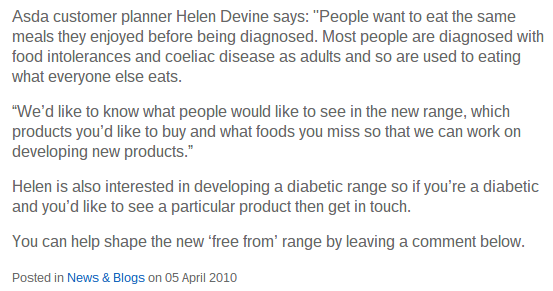
Not only did they want to create a diabetic range they were calling customers who had diabetes diabetics. A big no-no in my book. It looks like they didn't take that idea forward, but they do sell diabetic ice cream.
Waitrose has a page dedicated to diabetes, once again we see a supermarket calling its customers who have diabetes diabetics (and they also use the phrase diabetic control - another no-no!) and they clearly point out there is no need to buy diabetic products.

.
..but following the double standards of Morrisons you can happily buy diabetic jam and ice cream.
Marks and Spencer also have a whole page on how to be healthy with diabetes, referring people to the Diabetes UK website and making it clear "suitable for diabetics" products should be avoided.

It's difficult to be sure but I'm not aware of any products specifically labelled as diabetic in M&S - more research is needed!
And finally, Sainsburys. Sainsburys has a policy referring people to the Diabetes UK positional statement but like many of the other supermarkets they are calling their customers with diabetes diabetics.

Unlike Morrisons and Waitrose however they seem true to their word and I can find no products labelled diabetic. Please let me know if you know of any products that they sell that doesn't align with their policy statement above.
But even Sainsburys isn't impervious to the food industries marketing machine, with many products now having the claim "suitable for diabetics" somewhere on the product labelling. The most common place to find them is on chocolate and sugar products. One example is Choc Shots, which like all the food in the store is suitable for people with diabetes as part of a healthy diet.
 |
| "suitable for diabetics (as part of a healthy diet)" |
Asda even manages to sell soup that is apparently "suitable for diabetics" - who would have thought someone with diabetes could eat soup! *sigh*
 |
| Sarcasm on full: Soup I can eat - it must be a first! |
I'd certainly like to see the supermarkets take more of a stand on this issue and put some pressure on the food manufactures to change their labelling and remove references to diabetics. Supermarkets definitely need to be part of the solution and not part of the problem. I have no problem with products being labelled as low in sugar or low GI, but that does not make them diabetic or suitable for diabetics!
Regulation, laws, directives...
Surely the law regulates this kind of thing? Isn't the food industry one of the most highly regulated industries? How do they get away with it? Well I'm no lawyer and looking at all the regulations and directives all that is clear to me is that these documents are impenetrable and instantly cause my brain to switch off given the language used.
What I do know is the European Food Safety Authority states:
Health claims made in relation to food products require authorisation under Regulation EC 1924/2006 before they can be used in the labelling and marketing of these products in the EU
Within that regulation point 22 says:
(22) Conditions for claims such as ‘lactose-free’ or ‘gluten-free’, addressed to a group of consumers with specific disorders, should be dealt with in Council Directive 89/398/EEC of 3 May 1989 on the approximation of the laws of the Member States relating to foodstuffs intended for particular nutritional uses ( 9 ). In addition, that Directive provides the possibility that foodstuffs for normal consumption can indicate their suitability for use by these groups of consumers if they fulfil the conditions for such statement. Until the conditions for such statements are set at Community level, Member States may maintain or adopt relevant national measures.
I have no idea what the directive means in real terms. I also found this document Proposal for a Regulation of the European Parliament and of the Council on foodintended for infants and young children and on food for special medicalpurposes (First reading) (Legislative deliberation) with lots to say on the subject such as:
(7) Directive 2009/39/EC foresees that specific provisions could be adopted regarding the two following specific categories of food falling within the definition of foodstuffs for particular nutritional uses: 'food intended to meet the expenditure of intense muscular effort, especially for sportsmen' and 'food for persons suffering from carbohydrate metabolism disorders (diabetes)'. As regards special provisions for food for persons suffering from carbohydrate metabolism disorders (diabetes), a Commission report to the European Parliament and to the Council concludes that the scientific basis for setting specific compositional requirements is lacking.
I'm totally baffled. Hopefully someone with a better understanding of the law can explain the rules in terms that mere mortals can understand but, the long and the short of it is, "diabetic products" are out there; products claiming to be "suitable for diabetics" are out there and; this marketing approach is increasing. In my eyes this is wrong but what can be done?
Should we be lobbying the food industry? Challenging the NHS on the food they provide to inpatients? Lobbying the supermarkets to apply pressure for change? Lobbying our MPs to tackle this issue? Or as Diabetes UK positional statement says "Members of the public can make complaints about food labelling that they consider to be misleading to their local Trading Standards team"? Well, maybe we should be doing all of these things.
What do you think?
